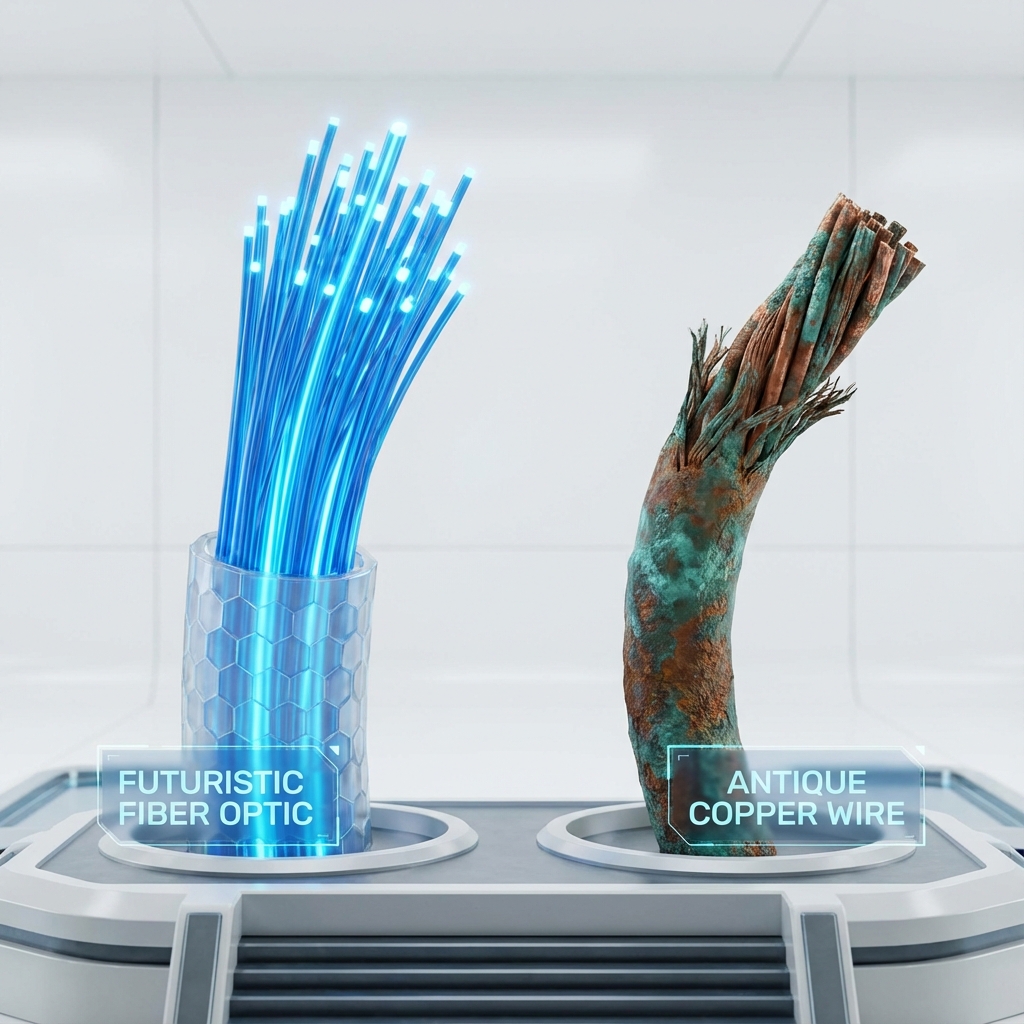
In the rapidly evolving world of digital connectivity, the choice of your internet connection can make or break your online experience. For decades, DSL (Digital Subscriber Line) was the gold standard, utilizing existing copper telephone lines to bring the internet into homes across India. However, a new champion has emerged, and it operates at the speed of light: Fiber Optics.
At Sky Digital, we often get asked by our customers in Botad: "Is Fiber really that much better than my old connection?" The short answer is yes. But to understand why, we need to dive deep into the technology that powers both.
1. The Technology: Glass vs Copper
The fundamental difference lies in the transmission medium. DSL uses copper wire infrastructure that was originally designed for voice calls over a century ago. Data travels as electrical signals, which degrade over distance and are susceptible to electromagnetic interference from power lines, appliances, and even bad weather.
Fiber optic cables, on the other hand, transmit data as pulses of light through microscopic strands of glass or plastic. Light travels significantly faster than electricity effectively does through copper, and more importantly, it doesn’t degrade over long distances (attenuation is minimal) and is completely immune to electrical interference. This means that a thunderstorm won't cause your Zoom call to drop.
2. Speed Comparison: The Need for Speed
This is where the difference becomes undeniable. DSL connections typically top out at around 100 Mbps for very high-end VDSL lines, but the average user often sees speeds closer to 10-20 Mbps, especially if they live far from the exchange.
Fiber has virtually no such limits for consumer usage. Sky Digital offers plans starting at 40 Mbps and scaling up to 100 Mbps easily, with the technology capable of Gigabit speeds in the future. Furthermore, DSL is "asymmetric," meaning your download speed is fast, but your upload speed is a fraction of that (often less than 1 Mbps). Fiber allows for "symmetrical" connections—if you have 100 Mbps download, you get 100 Mbps upload. This is critical for:
- Video Conferencing (Zoom, Teams, Google Meet)
- Uploading YouTube videos or content creation
- Cloud backups (Google Photos, iCloud, Drive)
- Online Gaming
3. Reliability and Latency
Have you ever experienced "lag" in a game? That's latency. Fiber offers significantly lower latency (often single-digit milliseconds) compared to DSL (20-50ms+). Lower latency means your clicks register instantly, webpages load snappier, and real-time interactions feel natural.
Because fiber is buried and doesn't rust or corrode like copper, it is far more durable. Sky Digital's fiber network in Botad boasts a 99.8% uptime reliability, ensuring that you stay connected when it matters most.
Conclusion
While DSL served us well in the past, Fiber is the clear winner for the modern digital home. It supports 4K streaming on multiple devices, seamless work-from-home setups, and lag-free gaming.
Ready to Upgrade?
Switch to Sky Digital Fiber today and experience the difference.
Check Availability in Botad